A Brief History of Time Travel: From Ancient Myths to Wormhole Physics
Halfway through a Brakeless run, a wormhole throws your car a century into the future. That one game beat sits at the end of a very long road: humans have been telling stories about slipping through time for at least thirteen centuries, physicists have spent the last one deciding which of those stories are legal, and — in one of science's best plot twists — a novelist once changed the physics itself. This page traces that road, and finishes with a report card: which famous time-travel stories would real physics actually allow?
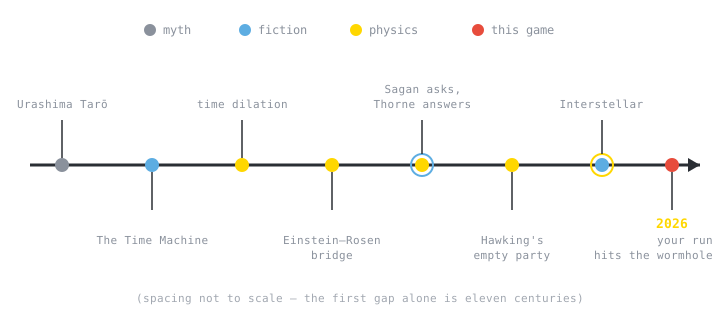
The ancient travellers all went forward
The oldest time-travel stories weren't written as science fiction — and yet they follow a rule modern physics would approve of. In Japan, texts from the 8th century (the Nihon Shoki chronicle, the Man'yōshū poetry collection) already record the tale of Urashima Tarō: a young fisherman who spends what feels like a few days in a palace beneath the sea and returns home to find that centuries have passed, everyone he knew long dead. In Hindu scripture, King Kakudmi takes his daughter Revati to visit the creator-god Brahma to ask about her marriage; Brahma laughs and explains that during their short audience, entire ages have elapsed on Earth — by the time they return, humanity itself has changed. Washington Irving's Rip Van Winkle (1819) plays the same trick with a twenty-year nap.
Notice what none of these travellers do: go backward. Time in the old stories is a river — you can be swept downstream faster than everyone else, but nobody swims home against the current. A thousand years before Einstein, the myth-makers had, by accident, landed on exactly the version of time travel that relativity would later make real. The game's science page covers that modern half: fly fast enough or sit deep enough in gravity, and you genuinely skip ahead.
1895: Wells builds the machine
Time travel as a technology — a dial you set, a lever you pull — is younger, and has a birthday: H. G. Wells's The Time Machine (1895), which put the phrase itself into the language. His unnamed Time Traveller rides forward to the year 802,701 to watch humanity's far future, which physics would happily permit. It's the return trip to tell the tale — casually pedalling back against the current — that breaks the rules, and that break would take physicists another century to formally object to. (Mark Twain had sent a Connecticut Yankee backward to King Arthur's court six years earlier, but by bump on the head rather than machine — fantasy's loophole.)
1905–1949: physics catches up, then gets nervous
Ten years after Wells, Einstein's special relativity turned forward time travel from fable into measurable fact: moving clocks run slow, so travelling fast is travelling to the future. General relativity (1915) added gravity to the recipe, and in 1935 Einstein and Nathan Rosen found their famous "bridges" — the wormholes every science-fiction writer has borrowed since. Then, in 1949, the logician Kurt Gödel handed his friend Einstein a genuinely unsettling birthday present: a solution to Einstein's own equations describing a rotating universe in which closed loops through time exist — travel into the past, allowed by the mathematics. Einstein admitted the result disturbed him. The equations, it turned out, were more permissive than the universe seemed to be — a tension physics has been managing ever since.
1985: a novelist changes the physics
Here is the strangest hop in this whole timeline: the modern science of traversable wormholes exists partly because of a novel. In 1985, Carl Sagan was finishing Contact and wanted his heroine to cross the galaxy in a way a physicist couldn't laugh at — so he asked one, his friend Kip Thorne at Caltech. Thorne took the homework seriously, worked out what it would actually take to hold a wormhole open for passage, and in 1988 published the results with Mike Morris as a landmark paper on traversable wormholes — the one that established the need for "exotic matter" with negative energy that the science page talks about. Fiction asked physics a question; physics wrote a real answer; the answer became the standard toolkit of every serious wormhole story since. Including, at a distance of one direct inheritance, the glowing tunnel at the 5,000-metre mark of this game.
2009: Hawking throws a party and nobody comes
Stephen Hawking suspected the universe forbids the backward trips — his "chronology protection conjecture" (1992) proposed that physics conspires to prevent time loops, "keeping history safe for historians". But his most charming argument was an experiment. On 28 June 2009, in Cambridge, he threw a party for time travellers — champagne, balloons, canapés — and only published the invitation afterwards, so that only someone travelling from the future could have known to attend. He sat for hours. Nobody came. It proves nothing, as Hawking cheerfully admitted — perhaps the invitations didn't survive, perhaps future guests have better parties — but it remains the wittiest null result in physics: an empty room as evidence about the structure of spacetime.
2014: the movie with a physicist in the credits
The Sagan–Thorne collaboration had a sequel. Thorne went on to co-produce Interstellar (2014), and held the film to the discipline that its wormhole and giant black hole obey his equations. Rendering the black hole Gargantua accurately was itself new work — the visual-effects code produced imagery detailed enough that it led to published physics papers. And the film's cruellest scene is just relativity, honestly applied: one hour on a planet deep in the black hole's gravity costs seven years back home — the Urashima Tarō story, retold with equations, thirteen centuries later. If you've driven far enough in Brakeless to watch the outside universe shrink behind you near the black hole, you've seen the same textbook, drawn in pixels.
The report card: which stories would physics allow?
Grade the classics by one rule — relativity permits travel to the future (time dilation is real, measured, routine), while travel to the past is, per Hawking's conjecture and every experiment so far, forbidden:
| Story | Year | Direction | Verdict |
|---|---|---|---|
| Urashima Tarō | ~700s | forward | ✓ accidentally Einstein-compliant |
| The Time Machine | 1895 | both | half legal — the trip out is fine, the trip home isn't |
| Planet of the Apes | 1968 | forward | ✓ textbook time dilation, spoiler included |
| Back to the Future | 1985 | backward | ✗ chronology protection says the DeLorean stays parked |
| Groundhog Day | 1993 | loop | ✗ a closed timelike curve with weather |
| Interstellar | 2014 | forward | ✓ the most physics-lawful blockbuster ever made |
| Brakeless | 2026 | forward only | ✓ wormhole to 2126, no reverse gear — by design |
Direction is the load-bearing test. Machines, wormholes and sea-palaces are negotiable; the arrow isn't.
Why Brakeless sits on the legal side
When we built the game's wormhole, the rule wrote itself: a car with no brakes shouldn't get a reverse gear in time either. The jump from 2026 to 2126 is one-way, the run never revisits the past, and the finale ends inside a black hole — the one place where "no going back" stops being a design choice and becomes the local law of geometry. The full physics of that ending — spaghettification, the photon sphere, why your best run technically never ends to an outside observer — lives on the science page. The other side of the game's what-if — what stopping a car actually costs in metres and physics — has its own page too.
Quick answers
What is the oldest time travel story?
Among the oldest with a clear time-slip: the Japanese tale of Urashima Tarō, recorded in 8th-century texts including the Nihon Shoki, and the Hindu account of King Kakudmi's visit to Brahma, in which ages pass on Earth during a brief audience. Both are forward-only — centuries lost, never regained.
Who invented the time machine (in fiction)?
H. G. Wells, in his 1895 novel The Time Machine, which coined the term and introduced the idea of time travel as a deliberate, mechanical act rather than a magical accident.
Is Interstellar scientifically accurate?
Unusually so: physicist Kip Thorne co-produced it and required its wormhole and black hole to obey general relativity, and the effort to render the black hole Gargantua accurately contributed to real published research. Its "one hour equals seven years" planet is legitimate time dilation, just placed in extreme gravity.
Did Stephen Hawking really throw a party for time travellers?
Yes — 28 June 2009, University of Cambridge, with the invitation published only after the party ended, so only a visitor from the future could have attended. Nobody came. Hawking called it experimental evidence (with a smile) that backward time travel never becomes practical.
Has anyone actually travelled in time?
To the future, yes — by tiny, measured amounts. Clocks on GPS satellites and astronauts on long missions genuinely experience less elapsed time than the rest of us; cosmonaut Sergei Krikalev is about a fiftieth of a second younger than he would be had he stayed on Earth. The science page has the details. To the past: no, and physics increasingly suspects, never.
The wormhole is 5,000 metres into the run, the future is one-way, and the myth-makers were right all along: you can only be swept downstream.