Wormholes, Time Travel & Black Holes: The Science Behind Brakeless
A run in Brakeless starts as an ordinary drive through a city center. Ten kilometres later you are inside a black hole, dodging the shredded remains of everything it has ever swallowed. In between, a wormhole throws you a hundred years into the future. It sounds like pure video-game nonsense — but a surprising amount of it is real physics, and the parts we invented, we invented on purpose. This page is the honest tour: what's real, what's stretched, and what's ours.
The Void: where the road leaves Earth
At 5,000 metres the forest ends and the run crosses into the Void — open space, no road, and a black hole dragging you through a field of asteroids. This is the game's first piece of black-hole physics, seen from the safe side: from a distance, a black hole is just gravity. It doesn't vacuum up the universe around it; things orbit black holes the same way planets orbit stars. Get close, though, and there is a boundary where the rules change — and the game saves that boundary for the finale.
The wormhole: a shortcut a century long
At the far edge of the Void, a wormhole grabs the run and the year counter on your dash starts glitching upward: 2026… 2054… 2091… 2126. You come out the other side on the same street you started on — a century later, grown into a six-lane hover avenue at midnight.
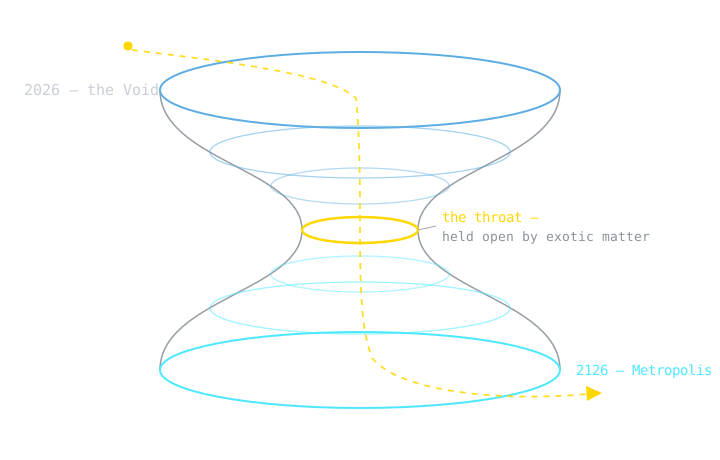
Wormholes are not fiction — at least not mathematically. In 1935, Albert Einstein and Nathan Rosen showed that the equations of general relativity allow "bridges": tunnels connecting two distant points of spacetime. Physicists later worked out what it would take for something to actually travel through one and survive, and there's the catch — a traversable wormhole needs to be held open by so-called exotic matter with negative energy density, a substance nobody has ever observed in the required amounts. So the scorecard reads: allowed by the equations, never seen in the sky, probably unbuildable. For a driving game, "allowed by the equations" was all the permission we needed.
One more honest detail: a wormhole that connects two times rather than two places is a legitimate theoretical construct too — several serious time-machine proposals in physics are built exactly that way. Ours only runs in one direction, and that's the next section.
Why the game only travels forward
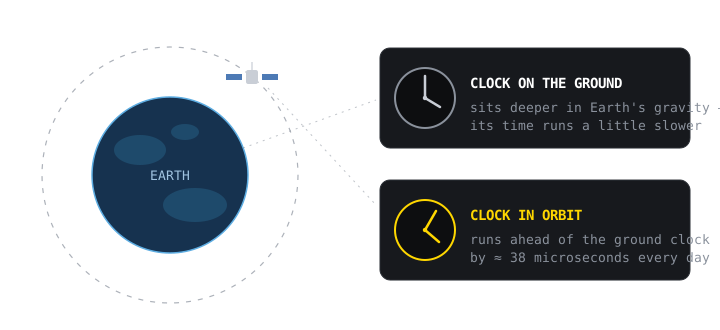
Here is the part most people find surprising: time travel to the future is not science fiction. It is measured, verified, everyday physics. Einstein's relativity says that clocks tick slower when they move fast or sit deep in gravity, and the effect is real enough that technology has to correct for it. GPS satellites carry clocks that run about 38 microseconds a day differently from clocks on the ground — uncorrected, satnav would drift by kilometres within a day. Cosmonaut Sergei Krikalev, after roughly 800 days in orbit, returned to Earth measurably younger than if he had stayed home — by about a fiftieth of a second. He is, in a strict physical sense, a time traveller. Fly fast enough for long enough and you could skip a century; nothing in physics forbids it. You just can't come back.
Travelling backward is a different story. It invites paradoxes (the classic: prevent your own trip from ever happening), and while general relativity technically contains exotic solutions with loops in time, most physicists suspect nature censors them — Stephen Hawking called this the "chronology protection conjecture", joking that it keeps history safe for historians. Brakeless takes the same side: the wormhole only runs forward, from 2026 to 2126, and no car in the game will ever drive into the past. A one-way trip also happens to fit a game about a car with no brakes: forward is the only direction that exists.
2126: the century you skip
The future half of the run deliberately mirrors the past half — the same world, one hundred years on. The city has grown into a neon metropolis of megatowers, holograms and delivery drones. The sea bridge has become a skyway: a ribbon of light swaying high above the clouds. The suburb hums with hovercars descending out of the night sky to join the street traffic, and the countryside has become an automated agri-grid — glowing fields, driverless harvesters, robotic herds crossing the road in lockstep. None of that is hard physics, just extrapolation with the dial turned up. The how-to-play guide covers what each of these scenes actually does to you at 250 km/h.
The black hole: an ending you can't brake out of
At 10,000 metres the run reaches the event horizon, and this is where the game's premise and real physics collapse into the same sentence. An event horizon is the distance from a black hole at which the escape velocity exceeds the speed of light. Nothing that crosses it comes back — not a ship, not a signal, not light itself. Inside the horizon, the geometry of spacetime is bent so severely that all paths lead inward; moving away from the centre becomes as impossible as moving into last Tuesday. In other words: past this line, stopping isn't against the rules. It's against the geometry of the universe. A game about a car that cannot stop was always going to end here.
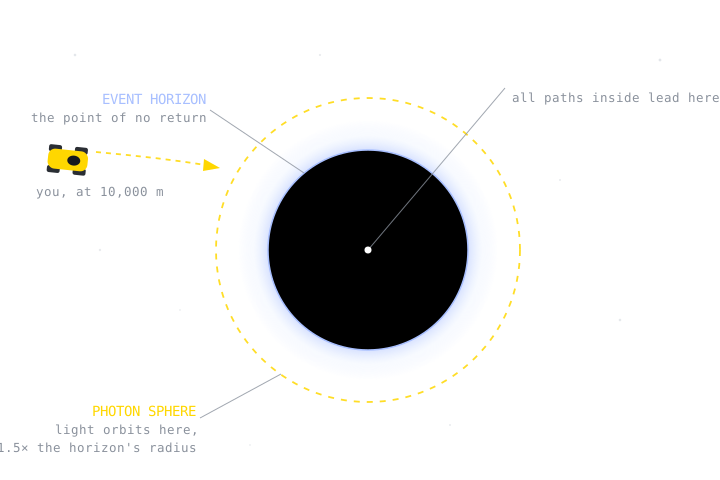
The details you see in the final scene are drawn from real phenomena, tuned for playability:
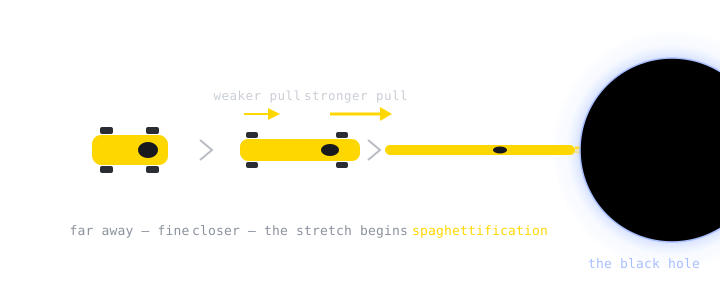
Spaghettification is a genuine scientific term (popularised by Stephen Hawking) for what a black hole's tidal forces do to infalling matter: gravity pulls harder on the near end of an object than the far end, stretching it into a long filament. The wreckage you weave through inside the hole — the drawn-out remains of everything it has eaten — is that process, made into an obstacle course.
The photon echo is our name for a real feature: at about one and a half times the horizon's radius, gravity is strong enough that light itself orbits the black hole. Some of the glow you see in the finale has, in effect, been lapping the hole for a very long time.
The shrinking universe behind you is real too. To an observer falling in, the light of the entire outside cosmos crowds together into an ever-smaller, ever bluer patch in the direction they came from — the last porthole out of a place with no exits.
And the endless final scene has one more physics joke buried in it. To a distant observer, someone falling toward a black hole appears to slow down, dim and freeze at the horizon — from the outside, the fall never visibly ends. So when your best run reaches the black hole and just keeps going: as far as the rest of the universe is concerned, it really is still going.
How much of this is real? Quick answers
Are wormholes real?
They are valid solutions to Einstein's equations of general relativity, proposed in 1935. None has ever been observed, and keeping one open for travel would require exotic negative-energy matter that may not exist. Mathematically respectable, practically unavailable.
Is time travel to the future possible?
Yes — it's measured routinely. Clocks on GPS satellites, particles in accelerators and astronauts in orbit all experience time slightly differently than we do on the ground, exactly as relativity predicts. Travelling to the future is only an engineering problem. Travelling to the past is where physics (probably) draws the line.
What is spaghettification?
The stretching of an object by a black hole's tidal forces — the pull on your near side exceeds the pull on your far side, and you get drawn out like pasta. For small black holes this happens well outside the horizon; for giant ones, only deep inside.
Could you survive crossing an event horizon?
Falling into a stellar-mass black hole, you'd be shredded by tides before you ever reached the horizon. Falling into a supermassive one — millions of times the Sun's mass — the crossing itself could be gentle, even unnoticeable. You'd remain intact for a while, still seeing the outside universe behind you. There is, however, no version of the story where you come back to tell it. The Brakeless black hole behaves like a supermassive one, which is why the run continues inside.
Why can't the run ever go back to the past?
Because forward time travel is real physics and backward time travel probably isn't — and Brakeless picks the real side. Also because a game with no brakes shouldn't have a reverse gear in time, either.
Ready to test the geometry yourself? The event horizon is 10,000 metres from the start line, and the accelerator is already down.