Why You Really Can't Drive Without Brakes: The Physics of Stopping
Brakeless is built on one deleted pedal. The whole game asks a single what-if — what if a car could only steer? — and then makes that your problem for ten thousand metres. This page is the serious version of the joke: what stopping a real car actually involves, why the numbers are so much worse than intuition says, and why every real road you've ever driven on is quietly designed around them.
Stopping is two distances, not one
By the time a car stands still, it has covered two very different stretches of road. The first is the reaction distance: the ground covered between the moment a hazard appears and the moment your foot actually presses the pedal. Nothing about the car matters here — this one is entirely human. Perceiving, deciding and moving your foot takes roughly a second and a half for an average alert driver, and at highway speed a second and a half is a very long way.
Only then does the second stretch begin: the braking distance, where the tyres and the road fight your momentum down to zero. On dry asphalt, with good brakes and an ordinary car, the round numbers look like this:
| Speed | Reaction (1.5 s) | Braking (dry road) | Total |
|---|---|---|---|
| 50 km/h | 21 m | 14 m | ≈ 35 m |
| 100 km/h | 42 m | 56 m | ≈ 98 m |
| 150 km/h | 63 m | 126 m | ≈ 189 m |
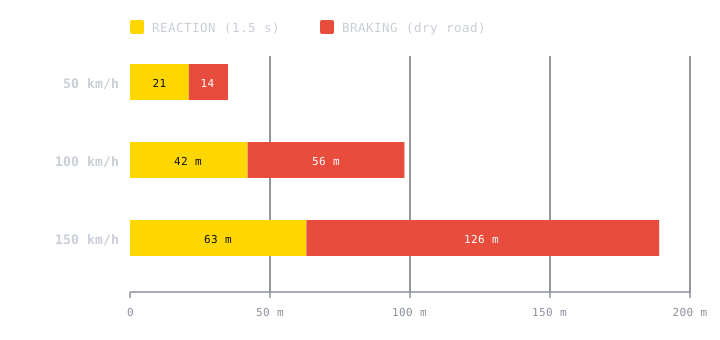
Read the middle row again: at 100 km/h you need roughly a full football pitch to stop — and almost half of it is gone before the car even begins to slow down. At city speeds the reaction distance is the killer; you cover more ground deciding to brake than braking. At highway speeds the balance flips, and that flip is the next section.
The tyranny of the square
Here is the single most important — and least intuitive — fact in road physics: braking distance grows with the square of speed. Twice as fast does not mean twice as far to stop. It means four times as far. Three times as fast means nine times as far. In the table above, going from 50 to 150 km/h triples the speed — and multiplies the braking distance by nine, from 14 metres to 126.
The reason is energy. A moving car carries kinetic energy equal to ½mv² — mass times speed squared — and brakes are machines for converting every joule of it into heat. Double the speed and there is four times the energy to burn off through four palm-sized patches of rubber. There's a vivid way to picture how much energy that is: stopping from a given speed destroys exactly as much energy as falling from a certain height. The formula is h = v²/2g, and the mass of the car cancels out entirely — it's the same height for a bicycle and a truck.
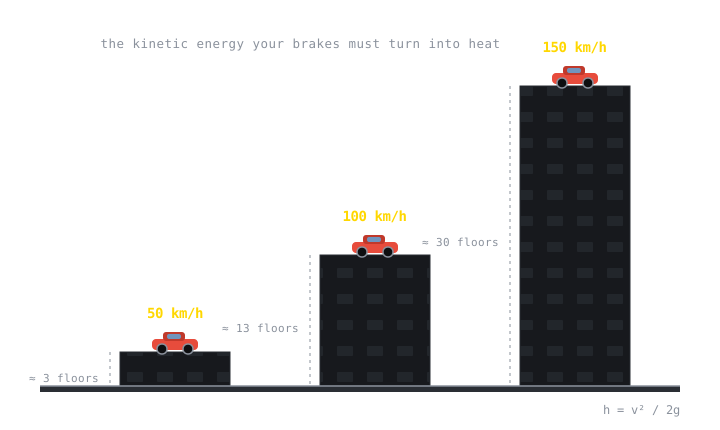
This square law is why speed limits step down so aggressively near schools, why motorway exits have long deceleration lanes, and why "I was only going a little faster" is the most expensive sentence in driving. A little faster is a lot further.
Your brakes are stronger than your engine
A pleasant surprise hiding in the same arithmetic: braking is the most powerful thing an ordinary car does. A family car needs ten seconds or so of full engine power to reach 100 km/h, but good brakes will erase that speed in around three seconds. Same energy, one third of the time — which means your brakes are roughly three times more powerful than your engine. They just spend that power as heat in the discs instead of noise and motion. It's also why brakes, not engines, are what fails first when they're overworked — a story with its own page: real brake failures that changed how vehicles are built.
The two-second rule is this maths folded into a habit
Driving instructors compress all of the above into one rule: stay at least two seconds behind the car ahead. Two seconds of travel roughly covers your reaction distance plus a margin, at any speed — that's the trick of counting time instead of metres. It works for a subtler reason too: you almost never have to out-brake a wall. The car ahead also needs distance to stop, so what you really need to match is its braking, delayed by your reaction. Two seconds buys exactly that. Tailgating at half a second doesn't make you a sharper driver; it makes you a passenger in the other car's emergency.
What Brakeless does with all this
The game takes this physics seriously — from the wrong side. Your car holds 150–300 km/h with no brake pedal, so the entire sport is converting what would be braking problems into steering problems: if a gap is closing, you can't arrive later, you can only arrive somewhere else. The difficulty tuning under the hood is, in effect, reachability maths — at your current speed, can steering alone still carry you to the open lane? — which is the same question a real driver's brain asks, minus its favourite answer.
And one detail worth noticing mid-run: the other cars in Brakeless do brake. Traffic queues up behind roadworks and stops for pedestrian crossings, because a world where nothing can stop wouldn't have traffic at all — it would have wreckage. You are the only vehicle in the game with the physics switched off. The how-to-play guide covers what to do about that; the science page covers where the road eventually leads, which is a place where stopping is forbidden by geometry rather than by game design.
Quick answers
What is the stopping distance at 100 km/h?
On dry asphalt, with an alert driver: roughly 98 metres — about 42 m of reaction distance plus 56 m of braking. That's approximately the length of a football pitch. In rain, or with a tired or distracted driver, it can easily double.
Does doubling your speed double your braking distance?
No — it quadruples it. Braking distance follows the square of speed, because kinetic energy does. This is the least intuitive number in driving, and the one most worth knowing.
How long is human reaction time behind the wheel?
Around 0.7 to 1.5 seconds to perceive a hazard, decide, and move your foot — longer when tired or distracted. At 150 km/h, that is 29 to 62 metres travelled before the car begins to slow at all.
Do heavier cars take longer to stop?
Less than you'd think, at first: in the ideal physics, mass cancels out — a heavier car has more energy but also presses its tyres harder into the road. In practice, tyres and brakes saturate: a loaded 40-tonne truck needs far more road than any car, which is why trucks get lower speed limits, longer following distances and their own fail-safe braking systems.
What is the two-second rule?
Keep at least two seconds of travel time between you and the vehicle ahead — pick a roadside marker, and if you pass it less than two seconds after the car in front did, drop back. Counting time instead of distance makes the rule self-adjust to any speed.
Or experience the alternative: a car with the square law fully armed and no way to pay it off. The run starts at 150 km/h and only ever gets faster.