When Brakes Fail: Real Failures That Changed How Vehicles Are Built
Brakeless is a fantasy about a car that cannot stop. The stories on this page are not. Real brake failures have shaped a century and a half of engineering — and the remarkable pattern is that each famous failure produced a fix that is now built into every vehicle around you. People died in several of these events; we tell them here not as spectacle, but because they are the reason the machines changed. Your car is, in a very literal sense, a museum of lessons learned the hard way.
1869: the brake that fails ON
Before the air brake, stopping a train was a job done by hand — literally. On a signal from the engineer, brakemen would clamber along the roofs of moving cars, cranking a brake wheel on each one in turn. It was among the most dangerous jobs in America, and it barely worked: a heavy train might need a kilometre or more of frantic cranking to stop.
In 1869, a 22-year-old inventor named George Westinghouse patented the railway air brake — one pipe of compressed air, running the length of the train, applying every brake at once from the cab. But his masterpiece came a few years later with the automatic air brake, which inverted the logic: air pressure now held the brakes off, against springs, with a reservoir on every car. Burst a hose, split the train in half, lose the compressor — the air escapes, and every brake on every car slams on by itself. Engineers call this fail-safe design: the system's failure mode is braking. The United States made air brakes mandatory with the Railroad Safety Appliance Act of 1893, and accident rates fell sharply. A century and a half later, every heavy truck on the highway still works this way — powerful springs try to clamp the brakes at all times, and only air pressure holds them open. A truck that loses its air doesn't lose its brakes. It stops.
1968: never again all four wheels
Cars took a different path — hydraulic fluid instead of air — and inherited a different weakness. For decades, a car's brakes were plumbed as a single circuit: one master cylinder, one web of lines, all four wheels. One rusted-through line, one torn seal, one slow leak that nobody noticed, and the pedal went softly, uselessly to the floor. Not weaker brakes — no brakes, at whatever speed you happened to be doing.
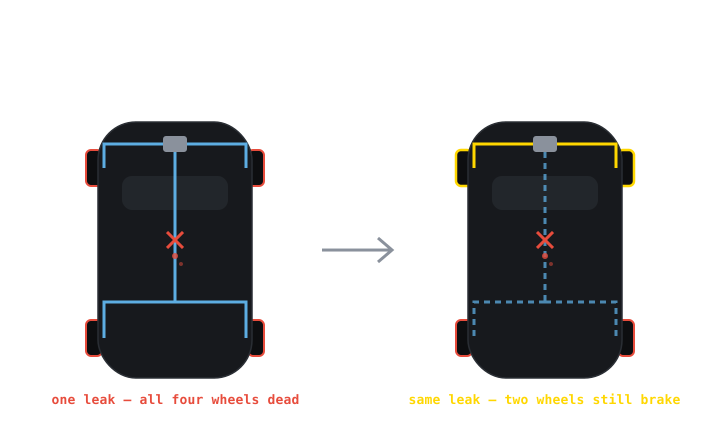
The fix arrived with the first US federal motor vehicle safety standards: from 1968, FMVSS 105 required split brake circuits — two independent hydraulic systems, so a single failure can only take out part of the car's braking, along with a red warning lamp to tell you it has happened. That's why "the brake lines were cut" is a movie plot from a world before 1968: sabotage or corrosion now has to defeat two separate systems to leave a modern car truly brakeless.
Brake fade: the mountain always wins the heat contest
Here is the failure that still happens today, and the one closest to this game's premise. As the physics page explains, brakes are machines for turning motion into heat — and they can only shed that heat so fast. On a long mountain descent, a fully loaded truck feeding gravity into its brake drums for kilometre after kilometre can push them past 300 °C, and the friction surfaces simply stop gripping. The pedal still moves; nothing bites. It's called brake fade, and it isn't a leak or a defect — it's thermodynamics winning. This is why mountain highways bristle with STEEP GRADE signs, mandatory truck brake-check pull-offs, and low-gear warnings: the only sustainable way down is engine braking, which spends the energy somewhere other than the brakes.
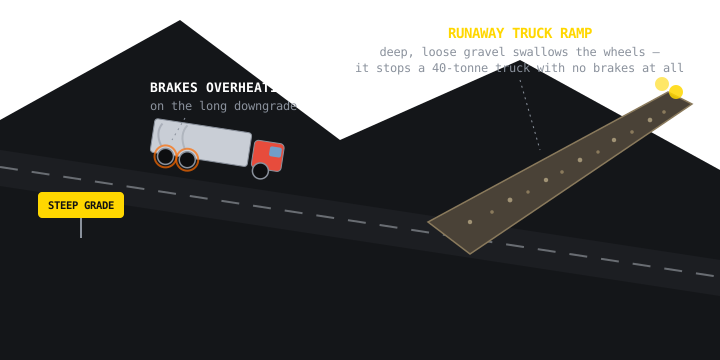
And for the day all of that fails, engineers built the most Brakeless piece of infrastructure in existence: the runaway truck ramp — an escape lane branching off the downgrade into a few hundred metres of deep, loose gravel that swallows a truck's wheels and drags even a 40-tonne runaway to a stop. It is a road designed on the assumption that brakes are gone.
The modern case that made this failure famous: in April 2019, a lumber truck lost its brakes descending Interstate 70 out of the Rocky Mountains toward Denver. The driver, 23-year-old Rogel Aguilera-Mederos, passed a marked runaway ramp and struck stopped traffic at around 85 mph, igniting a pile-up of 28 vehicles. Four people died. Colorado's mandatory-minimum sentencing rules then stacked his convictions into a 110-year prison sentence — a result so disproportionate that around five million people signed a petition against it, and the state's governor cut it to ten years within weeks. The crash is now taught in trucking schools as the textbook case for two rules: check your brakes before the grade, and if they're gone, take the ramp — it exists for exactly that moment.
When the human is the weak link: ABS, brake override, and cars that brake themselves
The last century of brake engineering has a plot twist: once the hardware became nearly unbreakable, the remaining failures moved into the driver's seat. A driver who slams the pedal in a panic locks the wheels — and a car with locked front wheels cannot steer at all, only slide. The answer, borrowed from aviation, was the anti-lock braking system: Bosch and Mercedes put the first production ABS in a car in 1978, releasing and re-applying the brakes many times per second so the tyres keep rolling and the steering keeps working. It quietly became one of the most effective safety devices ever fitted.
Then came 2009, and the failure nobody had designed for: a car braking with all its strength while its own engine fought back. An off-duty California Highway Patrol officer, Mark Saylor, was driving a loaner Lexus near San Diego when an incorrectly fitted all-weather floor mat trapped the accelerator pedal wide open; the car exceeded 120 mph, and a passenger's emergency call recorded the family's final seconds. All four occupants died. The crash triggered recalls of millions of Toyota and Lexus vehicles — among the largest in automotive history — and a ten-month federal investigation, with NASA engineers combing the electronics for ghosts. They found none: the causes were mechanical — trapped and sticking pedals. The lasting fix is software called brake override, now effectively universal: if the brake and the accelerator disagree, the brake wins. Always.
The newest chapter takes the driver out of the loop entirely. In 2024, US regulators finalised FMVSS 127: from September 2029, every new light vehicle sold in the US must carry automatic emergency braking — a car that watches the road, detects vehicles and pedestrians even at night, and applies its own brakes at speeds up to 90 mph if the driver doesn't. Regulators expect it to save hundreds of lives a year. Follow the arc: in 1869 the brakes learned to apply themselves when the machine failed. From 2029, they apply themselves when the human does.
What this means in Brakeless
Now the game's premise in its true light: Brakeless simply deletes all of it. No fail-safe springs, no second circuit, no ABS, no override, no ramp — a hundred and fifty years of stopping engineering, switched off at once, at 150 km/h and climbing. Notice, mid-run, that everyone else still has it: the traffic around you brakes for crossings and queues obediently behind roadworks, because a world where nothing stops wouldn't be a road, it would be a wreck. You are the one anomaly. How bad is that, numerically? The physics page puts it in metres and storeys — and the science page explains the one place the game takes you where stopping is impossible for everyone, everywhere, forever.
Quick answers
Why do trucks use air brakes instead of hydraulic ones?
Because air brakes are fail-safe by design, an idea inherited from George Westinghouse's 1869 railway brake: springs try to apply the brakes at all times, and air pressure holds them released. If a truck loses air pressure, its brakes engage rather than vanish. A hydraulic system's failure mode is the opposite — lose the fluid, lose the brakes.
What is brake fade?
The loss of braking power when brakes overheat. Friction turns motion into heat faster than the discs or drums can shed it, and past a certain temperature the friction surfaces stop gripping — the pedal works, the brakes don't. It's the main reason long descents have low-gear signs and truck brake-check areas.
What are runaway truck ramps made of?
Usually a long bed of deep, loose gravel or sand, often angled uphill, sometimes ending in energy-absorbing barrels. The material is the brake: wheels sink in, rolling becomes ploughing, and even a fully loaded runaway truck stops in a few hundred metres with no functioning brakes at all.
Can a modern car still lose its brakes completely?
It's rare by design. Split circuits mean a leak leaves you half a braking system; electronic parking brakes add another backstop; brake override handles a stuck throttle. The realistic total failure left is severe fade — overheated brakes on a long descent — which is a driving-technique problem (use low gear) more than a hardware one.
What is brake override?
Software, now effectively universal since the Toyota unintended-acceleration recalls, that cuts engine power whenever the brake and accelerator are pressed together. It guarantees that a car's brakes — which are stronger than its engine — can always win the argument.
And if you'd like to know, viscerally, why every one of these inventions matters — the run starts with all of them missing.