About Brakeless
Brakeless started with a single question: what does a driving game feel like when you take the brake pedal away? No speed management, no safety valve, just an accelerator stuck to the floor and your own nerve. Everything else in the game grew from that one constraint. You can't slow down, so every decision is about position, timing and how much risk you're willing to skim past at 200 km/h.
One run, eleven worlds
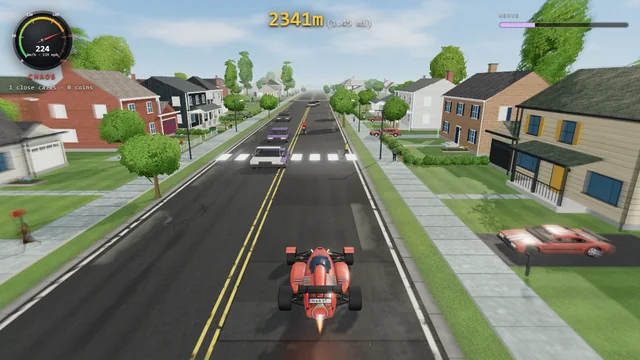
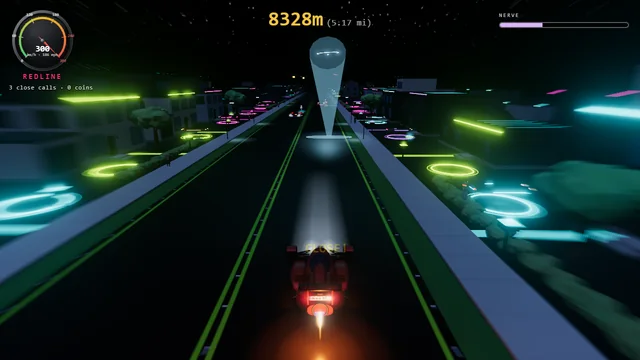
A single run carries you from a living city center (watch the pedestrians on the sidewalks), through rush-hour traffic, onto an eight-lane bridge with oncoming cars, down a narrow suburban street where cross-traffic pulses through junctions, where everyone else can stop and you can't, past countryside tractors and sheep herds, into a forest where the road disappears entirely, and through a black hole into an asteroid field in open space. And that's only half the journey: a wormhole then hurls you a century forward, to drive the same world again in 2126, through a neon midnight metropolis, a skyway over a glowing bay, a suburb of hoverboards and robot pedestrians and an automated farm grid, until the run ends where physics does, inside the event horizon of a black hole. That final scene is endless: the record hunt. The difficulty climbs in parallel through eight phases, from a calm cruise, past one bluntly named "Impossible", to the Event Horizon, where it stops getting easier forever.
Free, instant, private
The game runs entirely in your browser. There is nothing to download or install and no account required, and your high score, lifetime odometer and unlocked cars are stored locally on your own device. Open the page, press an arrow key, drive.
How it is built
Brakeless is written by hand in TypeScript, without a game engine. There is no Unity or Unreal underneath it and no level editor: the traffic, the collisions, the difficulty curve and all eleven worlds are plain code. The 3D view is drawn with WebGL through the open-source three.js library, which handles the low-level graphics and nothing else. Everything that makes it a game sits on top of that and was written for this project.
The road is generated as you drive. Nothing is laid out in advance, so no two runs are the same, but the scenery follows fixed rules: each world starts at the same distance every time, junctions and crossings sit where the scene guides say they do, and what you learn on one run carries over to the next. Before a new obstacle is placed, the game plays the road forward to make sure a way through still exists. Hard is the point, impossible is not.
The cars, buildings and trees are original models made for the game, generated by scripts rather than bought from an asset store. Their surface textures and the pedestrian figures come from public-domain sources. The sound effects and the engine note are synthesised live in your browser, so the engine really does rise with your speed rather than playing back a recording.
Two ways to play the same run
The game first went online in July 2026 as a top-down 2D driving game. The 3D version, with a chase camera behind the car, followed in September 2026 and is now what you get when you open the site. The original is still here as classic mode. Both run the same rules through the same eleven worlds, and both feed one leaderboard, where every entry is marked 2D or 3D.
The leaderboard
Signing in with Google is optional and does one thing: it puts your runs on the global board, under a driver name you choose. The board has a weekly table that resets every week, a ranking of drivers by the average of their recent runs, and a hall of fame for the longest runs ever driven. Runs are checked on the server before they count, and scores that could not have been driven are left off. What is stored when you sign in, and how to delete it, is set out in the privacy policy.
Who makes it
Brakeless is designed, programmed and maintained by one independent developer. There is no studio and no publisher behind it. The game is free, nothing in it is for sale, and every car in the garage is unlocked by driving. The site is intended to be supported by advertising shown alongside the game and the guides, never by anything you have to buy.
The game is updated regularly, and most of the changes come from players: a road that felt unfair, a hazard that appeared too late, a laptop it did not run smoothly on. If you have a report like that, or just a distance you are proud of, the address is on the contact page and every message is read.
New to the game? Start with the complete how-to-play guide, which covers the controls, scoring, the ghost shield and every scene in detail. For the real physics behind the premise, see what stopping a car actually takes and the science of the wormhole and the black hole.